People are reading less.
That’s a problem.
The infinite scroll and its algorithmically-boosted video content has stolen our attention and locked it away.
It’s easy to move with the herd… but it’s also easier than ever to be different. To read more, not less.
The world needs ideas that can’t be distilled into an Instagram reel or an AI-assisted LinkedIn post. And it needs people willing to invest 10 hours on a topic before they decide on a position and share it with the world (or choose not to).
Besides that, reading’s…well… kind of awesome. A way to live a thousand lives. A way to build empathy and challenge your worldview. A way to connect dots and a way to be a better citizen. A better parent or friend or co-worker. A way to be a better human.
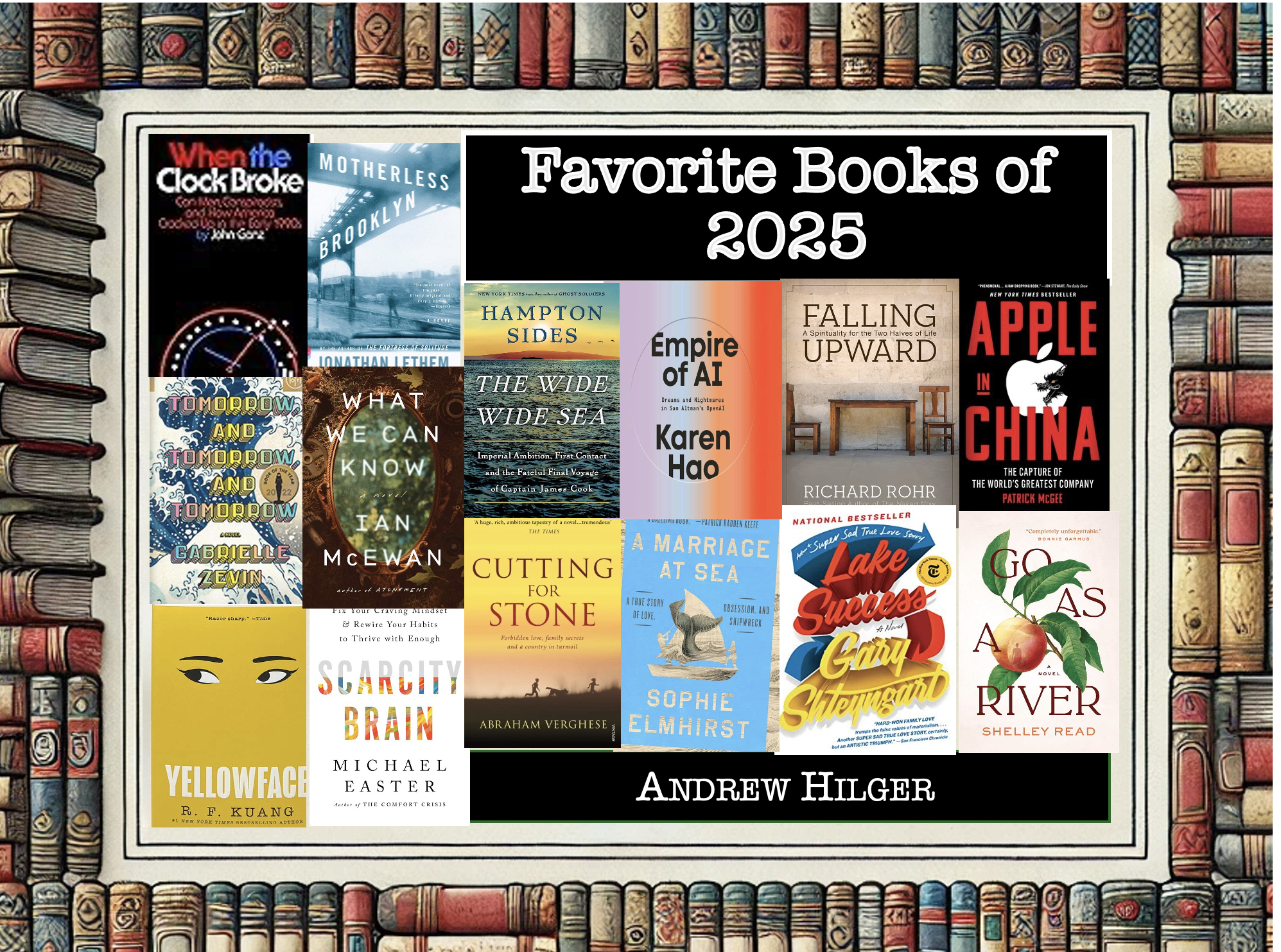
I read a lot of great stuff in ’25. Here are 14 books I couldn’t put down.
What books lit you up that I should add to my 2026 list?
If You’re Going to Read Just One (Fiction):
Go as a River — Shelley Read — A coming-of-age story set in rural Colorado. Human, devastating, and beautiful all at once. You’ll thank me!

If You’re Going to Read Just One (Non-Fiction):
The Wide Wide Sea — Hampton Sides — A page-turner that kept me thinking, “I can’t believe people chose to do this.” Captain Cook and the obsession with finding the Northwest Passage.

Other Incredible Fiction:
Yellowface — R. F. Kuang — Social commentary about the publishing world, with a front-row seat to ego, envy, and self-justification.
Motherless Brooklyn — Jonathan Lethem — A noir mystery powered by a singular voice—funny, tender, unforgettable.
What We Can Know — Ian McEwan — A bold premise that could’ve been gimmicky in lesser hands; McEwan makes it work (and it stuck with me for days). Elements of SF, mystery, and the best literary fiction.
Lake Success — Gary Shteyngart — A darkly comic sprint through modern anxiety—and the many traps of the rat race. If you haven’t read Shteyngart, this is a good starting place.
Cutting for Stone — Abraham Verghese — Epic in the best way: family, medicine, love, politics—the full sweep of a life.
Tomorrow, and Tomorrow, and Tomorrow — Gabrielle Zevin — I resisted this for a long time (maybe because it was everywhere). Glad I gave in; a great story about friendship, ambition, and creative obsession.
Other Incredible Non-Fiction:
Scarcity Brain — Michael Easter — Why stressed humans—and stressed systems—default to short-term thinking, even when it’s clearly self-defeating. Entertaining, illuminating, and practical.
A Marriage at Sea — Sophie Elmhirst — What possesses a couple to sail around the world—and what happens when a whale capsizes their boat? Wild, true, and hard to forget.
Empire of AI — Karen Hao — Wonder why we’re stuck in this AI race? Hao’s reporting (and the OpenAI story) explains a lot.
When the Clock Broke — John Ganz — A clear-eyed tour of the moment the U.S. story changed—Ganz traces a surprising amount back to the early 1990s. A fascinating window into how our current political climate came to be.
Apple in China — Patrick McGee — Is Apple using China, or is China using Apple? A look at the current geopolitical and tech ecosystem that shines a light on our current challenges to sort out global supply chains and manufacturing in general.
Falling Upward — Richard Rohr — A contemplative Catholic priest frames life as a two-stage journey: build the container, then fill it. Great for anyone wrestling with what the “second half” is for.