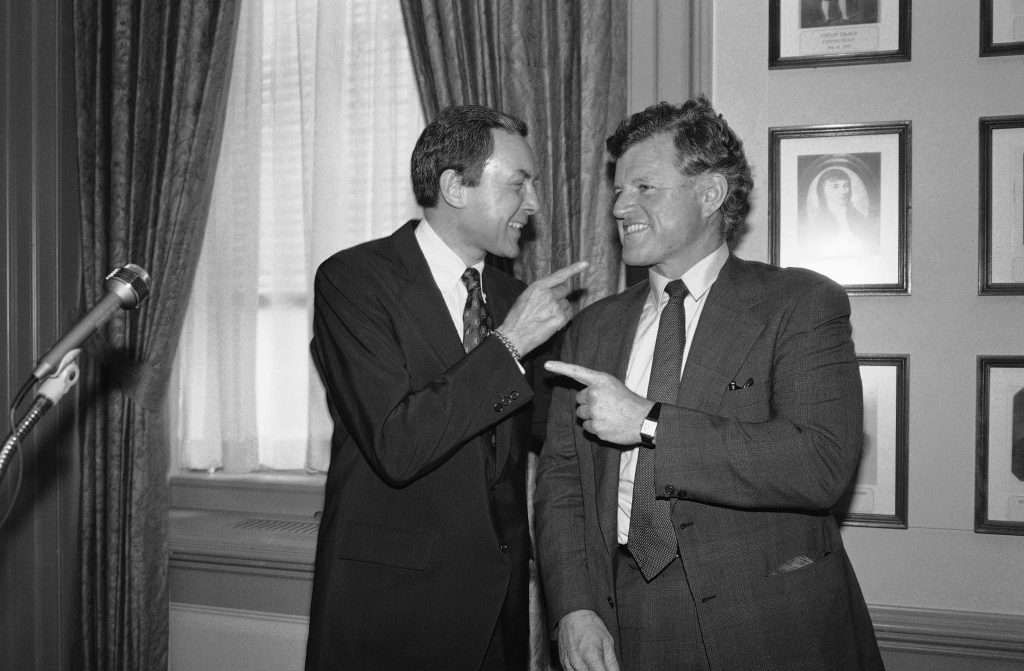
In the late 70s, Orrin Hatch arrived in Washington with one goal: Stop Ted Kennedy. Hatch, a dad-joking Mormon from Utah saw the liberal Kennedy as the embodiment of all that was wrong with Washington. Hatch didn’t drink or swear, and played wholesome songs on the piano. Kennedy, an establishment powerhouse, was larger than life in both politics and personality.
Early in his tenure, Hatch found his way onto the Labor and Human Resources Committee where he could square off against his Massachusetts rival and fulfill his mission. That seemed imminent when Republicans took the Senate in 1981, and Hatch became chair of the powerful committee.
Despite Hatch holding the gavel, though, two liberal Republicans often sided with Democrats—giving Kennedy, the ranking Democrat, a 9–7 ideological edge on many issues. Hatch realized that if he wanted to get anything done, he’d have to hold his nose and work with Kennedy.
What started as combat transformed into collaboration. Both had lines they wouldn’t cross… but they also realized they agreed on many key principles and became a bi-partisan force.
- They co-authored the Children’s Health Insurance Program (CHIP)
- Passed a law funding care and treatment for people living with HIV/AIDS (Ryan White CARE Act)
- Supported the Americans with Disabilities Act (ADA)
- Expanded NIH funding and promoted research into treatments for rare diseases
- And cooperated on Head Start reauthorization and student loan legislation
Along the way, they developed a close friendship. They talked often and attended one another’s birthday parties. One night, Kennedy called Hatch to tell him that Vicki Reggie, his future wife, cried when she heard a song Hatch had written in their honor.
“We didn’t agree on much, but we found a way to agree on things that really mattered,” said Hatch.
Kennedy called Hatch “a great legislator, a great friend, and a man of great principle.” He also often referred to him as “his brother.”
When Kennedy was diagnosed with a brain tumor, his dear friend and brother Orrin hatch wrote another song: “Headed Home.”
This bi-partisan friendship and connection seems hard to imagine today. Washington rewards demonization over collaboration. Leaders subordinate conscience to party, perform for clicks, and cling to power by stoking division.
French Philosopher Joseph de Maistre said, “Every nation gets the government it deserves.” By that thinking, we deserve our current dysfunction. It’s a reflection of our own division.
But that confuses causality. We’ve allowed platforms and their oligarchic owners to profit from outrage. We’ve allowed politicians to sort and label us—to convince us we’re at war with anyone they, or we, deem “other.”
We deserve better, and we should demand it. But that only happens when we behave better. When we reclaim our agency and stop demonizing “others.”
We need leaders who rise above our broken system. Leaders willing to build trust, find common ground, and find a better way forward. We need leaders who see one another’s common humanity. Who develop friendships despite difference.
Most of us don’t think we’re part of the problem. But when informed of divisive behavior, our instinct is to say, “but they…” That instinct makes us part of the problem.
It’s past time we’re part of the solution. It starts with how we treat one another in our communities and workplaces. As Kennedy and Hatch proved, we can build deep, trusting relationships, find the good, and move forward together.
It’s time to act our way into a new way of thinking.
We deserve to deserve better.